
Days of the Week in Arabic: Names, Pronunciation, and Regional Variations
Learning the days of the week in Arabic is essential for anyone studying the language, traveling, or working in Arabic-speaking countries. Arabic uses a combination of Modern Standard Arabic (MSA) for formal contexts and regional dialects such as Egyptian, Levantine, and Gulf Arabic, which can slightly alter pronunciation or spelling. Understanding these variations ensures clear communication and cultural accuracy.
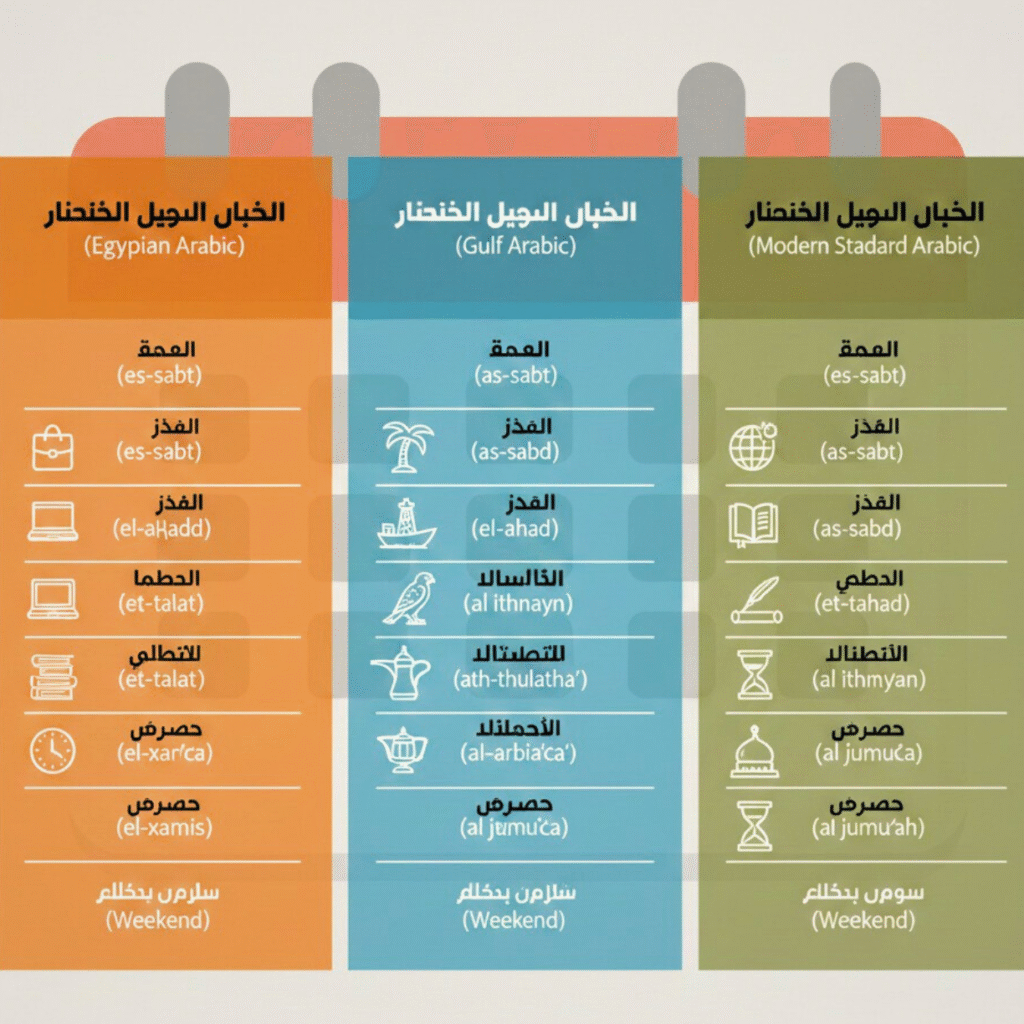
Days of the Week in Arabic: Names, Pronunciation, and Regional Variations
Learning the days of the week in Arabic is essential for anyone studying the language, traveling, or working in Arabic-speaking countries. Arabic uses a combination of Modern Standard Arabic (MSA) for formal contexts and regional dialects such as Egyptian, Levantine, and Gulf Arabic, which can slightly alter pronunciation or spelling. Understanding these variations ensures clear communication and cultural accuracy.
The Days of the Week in Arabic (MSA)
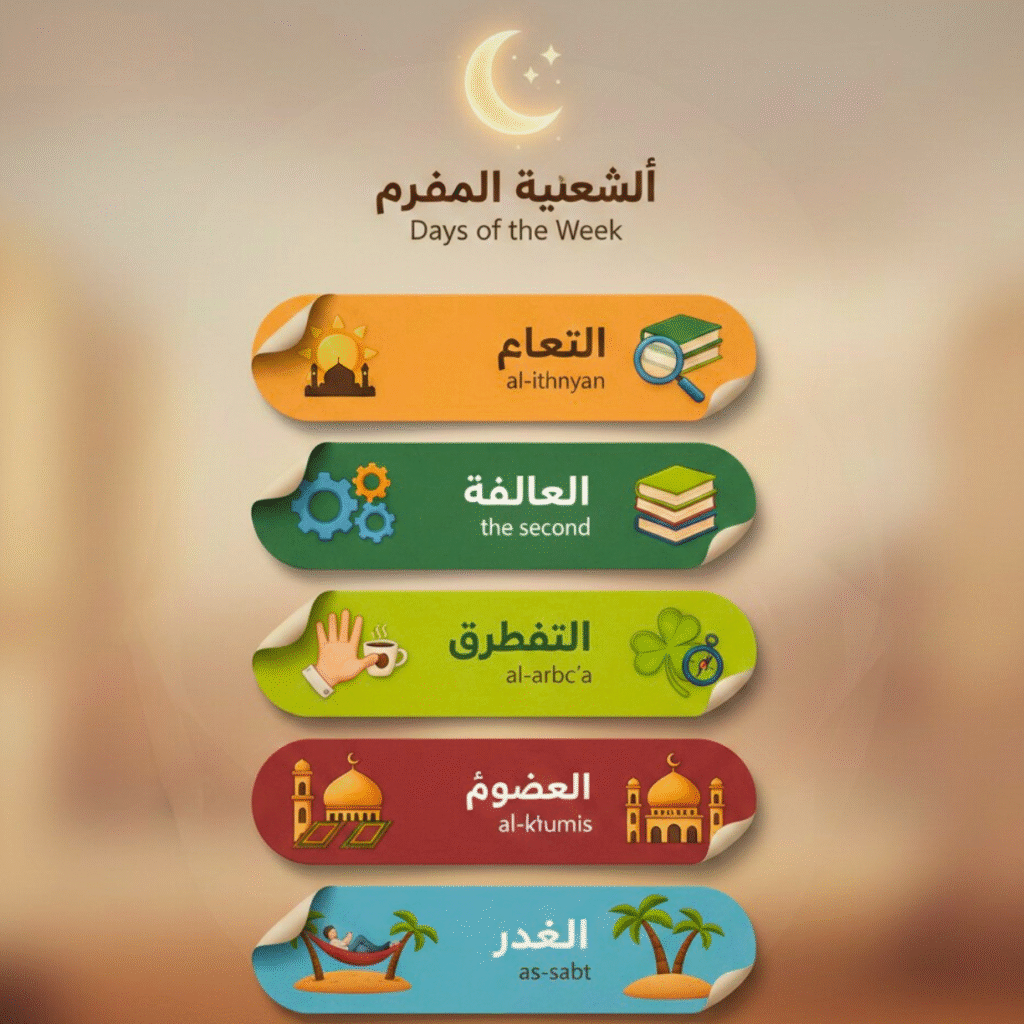
Here is the standard Modern Standard Arabic (MSA) list of weekdays:
| Day | Arabic Spelling | Pronunciation | Notes |
| Sunday | الأحد | al-ahad | Starts the Arabic week, often religious significance in some regions |
| Monday | الاثنين | al-ithnayn | Literal meaning: “The Second” |
| Tuesday | الثلاثاء | ath-thulatha | Literal meaning: “The Third” |
| Wednesday | الأربعاء | al-arba‘a | Literal meaning: “The Fourth” |
| Thursday | الخميس | al-khamis | Literal meaning: “The Fifth” |
| Friday | الجمعة | al-jum‘a | Day of prayer in Islam, regional holiday significance |
| Saturday | السبت | as-sabt | Literal meaning: “The Sabbath” |
This table is widely recognized across Arabic-speaking countries for formal use, printed materials, and official schedules.
Regional Variations in Arabic Weekdays
While MSA is standard, pronunciation and usage can vary across regions:
| Region | Sunday | Monday | Tuesday | Wednesday | Thursday | Friday | Saturday |
| Egypt | al-ahad | al-ithnayn | ath-thulatha | al-arba‘a | al-khamis | al-gum‘a | as-sabt |
| Saudi Arabia | al-ahad | al-ithnayn | ath-thulatha | al-arba‘a | al-khamis | al-jum‘a | as-sabt |
| UAE / Gulf | al-ahad | al-ithnayn | ath-thulatha | al-arba‘a | al-khamis | al-jum‘a | as-sabt |
Tip: Egyptian Arabic often softens consonants in speech, while Gulf Arabic may retain a closer alignment to MSA pronunciation.
Pronunciation Tips and Memory Techniques
- Learn in order: Start with Sunday (al-ahad) and repeat sequentially.
- Use flashcards: Combine Arabic script, Romanized spelling, and audio.
- Daily sentences: Integrate weekdays in simple sentences:
- “أنا أدرس العربية يوم الاثنين” – I study Arabic on Monday.
- Association method: Link each day to a personal routine or event to enhance recall.
- Practice with audio apps: Tools like Duolingo, Memrise, or regional Arabic podcasts provide pronunciation guides.
Practical Usage in Daily Life
Scheduling
When making appointments, it’s vital to use the correct weekday term for your region:
- Example: “The meeting is on Thursday.” → “الاجتماع يوم الخميس” (al-ijtima‘ yawm al-khamis)
Cultural Notes
- Friday (الجمعة / al-jum‘a) is a significant day in Islamic culture; most businesses close early, and Friday prayers are observed.
- Schools in Egypt and Saudi Arabia may use Sunday as the first day, while others consider Monday.
Travel & Business Applications
Using correct weekdays prevents miscommunication in:
- Hotel reservations
- Flight and train bookings
- Tour schedules
- Work meetings and conferences

Tools and Learning Resources
| Tool | Type | Regional Relevance | Cost / Pricing |
| Duolingo | App | Global | Free / Premium $12.99/mo |
| Memrise | App | Global | Free / Pro $8.99/mo |
| Local language schools | In-person | Egypt, UAE, Saudi Arabia | $50–$200/mo |
| YouTube Arabic pronunciation videos | Video | Global | Free |
| Flashcards / Printable PDFs | Offline | Global | Free / Purchase option |
Common Mistakes to Avoid
- Confusing dialectal pronunciation with MSA when addressing formal audiences.
- Skipping the gender agreement in sentences involving weekdays: some verbs or expressions change depending on context.
- Relying solely on Romanized spelling – it may lead to mispronunciation.
- Ignoring cultural significance of Friday and public holidays in scheduling.
Comparison of MSA vs. Regional Dialects
| Aspect | MSA | Egyptian Arabic | Gulf Arabic |
| Pronunciation | Standard | Softer consonants | Close to MSA |
| Usage | Formal, written, media | Everyday conversation | Formal & conversational |
| Spelling | Standard | Same | Same |
| Cultural Notes | Religious holidays universal | Socially casual | Includes local workweek patterns |
How to Memorize Arabic Weekdays Effectively
- Segment learning: Learn 2–3 days per day.
- Repeat aloud: Pronounce while writing each day.
- Use in context: Create sentences relevant to your life or profession.
- Regional immersion: Listen to native speakers from your target region.
- Daily review: Integrate spaced repetition to retain memory long-term.
Decision Framework for Learning Arabic Weekdays
When choosing learning tools or courses, consider:
- Goal: Travel, work, or formal education.
- Region: Egyptian, Gulf, Levant – pick a course matching target region.
- Format: In-person classes, online courses, apps, or mixed approach.
- Budget: $50–$200 per month depending on course type and region.
- Features: Includes pronunciation, writing, practice exercises, and voice examples.
Example Sentences with Weekdays
- Monday: “سأذهب إلى المدرسة يوم الاثنين” – I will go to school on Monday.
- Wednesday: “لدينا اجتماع يوم الأربعاء” – We have a meeting on Wednesday.
- Friday: “يوم الجمعة عطلة” – Friday is a holiday.
Learning Arabic Weekdays for Children
- Use songs and stories to teach weekdays.
- Combine color-coded flashcards for each day.
- Practice repeating days sequentially with daily routines.
Voice Search and AI Overview Tips
- Short-answer triggers: “What is Tuesday in Arabic?” → “Tuesday in Arabic is الثلاثاء (ath-thulatha).”
- Stepwise procedural answers: “How to say weekdays in Arabic?” → 1) Learn spelling, 2) Listen to audio, 3) Use in sentences.
- Comparison queries: “Differences in weekdays between Egypt and Saudi Arabia” → Highlight regional pronunciation.
People Also Ask (PAA) Style Questions
- What are the days of the week in Arabic?
- How do you pronounce Monday in Arabic?
- Are there differences between Arabic weekdays in Egypt and Saudi Arabia?
- How can I memorize Arabic weekdays quickly?
- Which apps help learn Arabic weekdays?
- How is Friday different culturally in Arabic countries?
- Can children easily learn Arabic weekdays?
FAQs
Q1: What is Sunday in Arabic?
A: Sunday is الأحد (al-ahad), the first day of the Arabic week.
Q2: How do you say Wednesday in Arabic?
A: Wednesday is الأربعاء (al-arba‘a).
Q3: Do weekdays differ in pronunciation across Arabic-speaking countries?
A: Yes. For example, Egyptian Arabic may soften certain consonants, while Gulf Arabic aligns closely with MSA.
Q4: Which day is considered a weekend in Arabic countries?
A: Friday (الجمعة / al-jum‘a) is the primary day off; some countries also include Saturday.
Q5: Are there apps for learning Arabic weekdays?
A: Yes. Popular apps include Duolingo, Memrise, and ArabicPod101, offering pronunciation guides and exercises.
Q6: How do I use weekdays in Arabic sentences?
A: Use the structure: “I [verb] on [day]” → “أنا [أفعل] يوم [الday]”. Example: “I study on Monday” → “أنا أدرس يوم الاثنين”.
Q7: Can learning Arabic weekdays improve my travel experience?
A: Absolutely. Correct weekday usage helps with booking travel, scheduling meetings, and interacting with locals.
Q8: How can children memorize Arabic weekdays?
A: Use songs, color-coded flashcards, and daily repetition through games or routines.
Conclusion
Mastering the days of the week in Arabic is foundational for effective communication, travel, work, and cultural understanding. By learning both MSA and regional variations, practicing pronunciation, and applying memory techniques, learners of all ages can gain confidence. Pairing structured study with apps, local classes, or daily practice ensures rapid and lasting retention. Use this guide to speak, write, and understand weekdays accurately in any Arabic-speaking region.

Muhammad Rehan
SEO Expert with 7+ Years of Experience
With over seven years of experience in Search Engine Optimization, I specialize in enhancing website visibility, driving organic traffic, and boosting online presence for businesses. My expertise spans technical SEO, content optimization, keyword research, link building, and data analytics. I have a proven track record of improving search rankings, enhancing user experience, and delivering measurable results for clients across various industries.